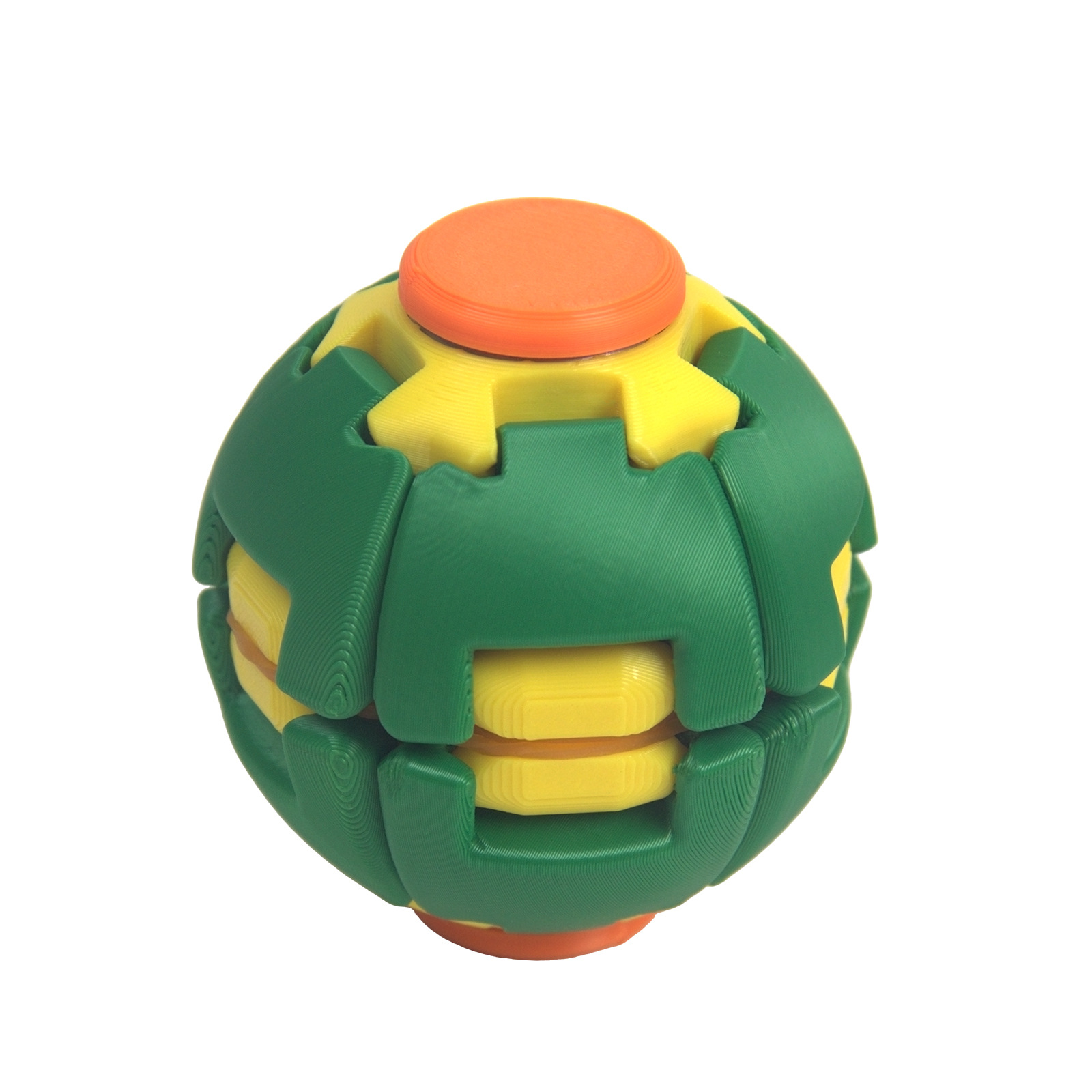
In recent months, 3D printed fidget balls have become one of the most popular products across social media platforms such as TikTok, Instagram Reels, and YouTube Shorts. Their satisfying movement, unique geometric designs, and mesmerizing flexibility have attracted millions of views, making them a perfect example of how additive manufacturing can transform creative ideas into functional products.
Unlike traditional stress relief toys, 3D printed fidget balls showcase the design freedom that only additive manufacturing can provide. Complex internal structures, rotating mechanisms, and flexible lattice patterns can be produced directly from 3D files without requiring expensive molds or complicated assembly. This makes them an excellent demonstration of modern 3D printing technology while also serving as practical everyday accessories.
What Makes 3D Printed Fidget Balls So Popular?
The appeal of these products goes far beyond their appearance. They combine engineering, creativity, and entertainment into a single compact object.
Some of the key features include:
- Smooth rotating or twisting motion
- Flexible lattice structures that are satisfying to squeeze
- Lightweight yet durable designs
- Print-in-place mechanisms requiring no assembly
- Eye-catching geometric patterns
- Endless opportunities for creative customization
Their interactive nature makes them enjoyable for both children and adults. Whether placed on an office desk or carried in a pocket, these small objects offer a simple way to relieve stress and improve focus.
The Advantage of 3D Printing
Traditional manufacturing methods often require costly tooling and long production cycles, making it difficult to produce products with intricate moving parts or customized designs.
3D printing eliminates these limitations.
Using additive manufacturing, designers can create highly complex geometries that would be impossible or extremely expensive to manufacture with conventional processes. Every layer is built precisely according to the digital model, allowing intricate details to be produced with remarkable accuracy.
Even better, design modifications can be made quickly by simply updating the 3D files. This flexibility significantly shortens development time and enables rapid product iteration without additional tooling costs.
Which 3D Printing Technology Is Best?
Different 3D printing technologies can be used depending on the desired appearance, material properties, and application.
SLS (Selective Laser Sintering) is ideal for producing durable nylon parts with excellent mechanical strength. It supports complex geometries without additional support structures, making it well suited for functional fidget toys with moving components.
SLA (Stereolithography) offers exceptional surface quality and fine detail. It is often chosen for high-precision prototypes or products that require a smooth finish and intricate textures.
FDM (Fused Deposition Modeling) remains a popular option for hobbyists and low-cost production. Flexible TPU materials can also be used to create soft, squeezable fidget balls with impressive elasticity.
Each technology offers unique advantages, and selecting the right process depends on the specific product requirements.
Endless Design Possibilities
One of the greatest strengths of additive manufacturing is design freedom.
Manufacturers can easily produce:
- Spiral fidget balls
- Twist-and-turn spheres
- Lattice compression balls
- Gyroid structures
- Print-in-place mechanisms
- Customized logos and branding
- Personalized colors and textures
Because no dedicated tooling is required, businesses can efficiently manufacture limited editions, promotional products, or customized gifts without increasing production costs.
From Prototype to Production
What starts as a creative concept can quickly become a market-ready product through 3D printing.
Designers can validate ideas with functional prototypes, test ergonomics, optimize internal structures, and move directly into low-volume production. This streamlined workflow reduces development risks while accelerating time to market.
For startups, product designers, educational institutions, and consumer brands, 3D printing provides an efficient solution for developing innovative products while maintaining flexibility throughout the design process.
Looking Ahead
The growing popularity of 3D printed fidget balls reflects a broader trend in modern manufacturing. Consumers increasingly appreciate products that combine creativity, personalization, and functionality—qualities that additive manufacturing delivers exceptionally well.
As 3D printing technologies continue to evolve, we can expect even more sophisticated designs, improved materials, and higher production efficiency. Whether for rapid prototyping, customized consumer products, or small-batch manufacturing, additive manufacturing is opening new possibilities across countless industries.
If you’re looking to transform your ideas into high-quality 3D printed products, professional additive manufacturing services can help bring your designs from concept to reality with speed, precision, and exceptional quality.


